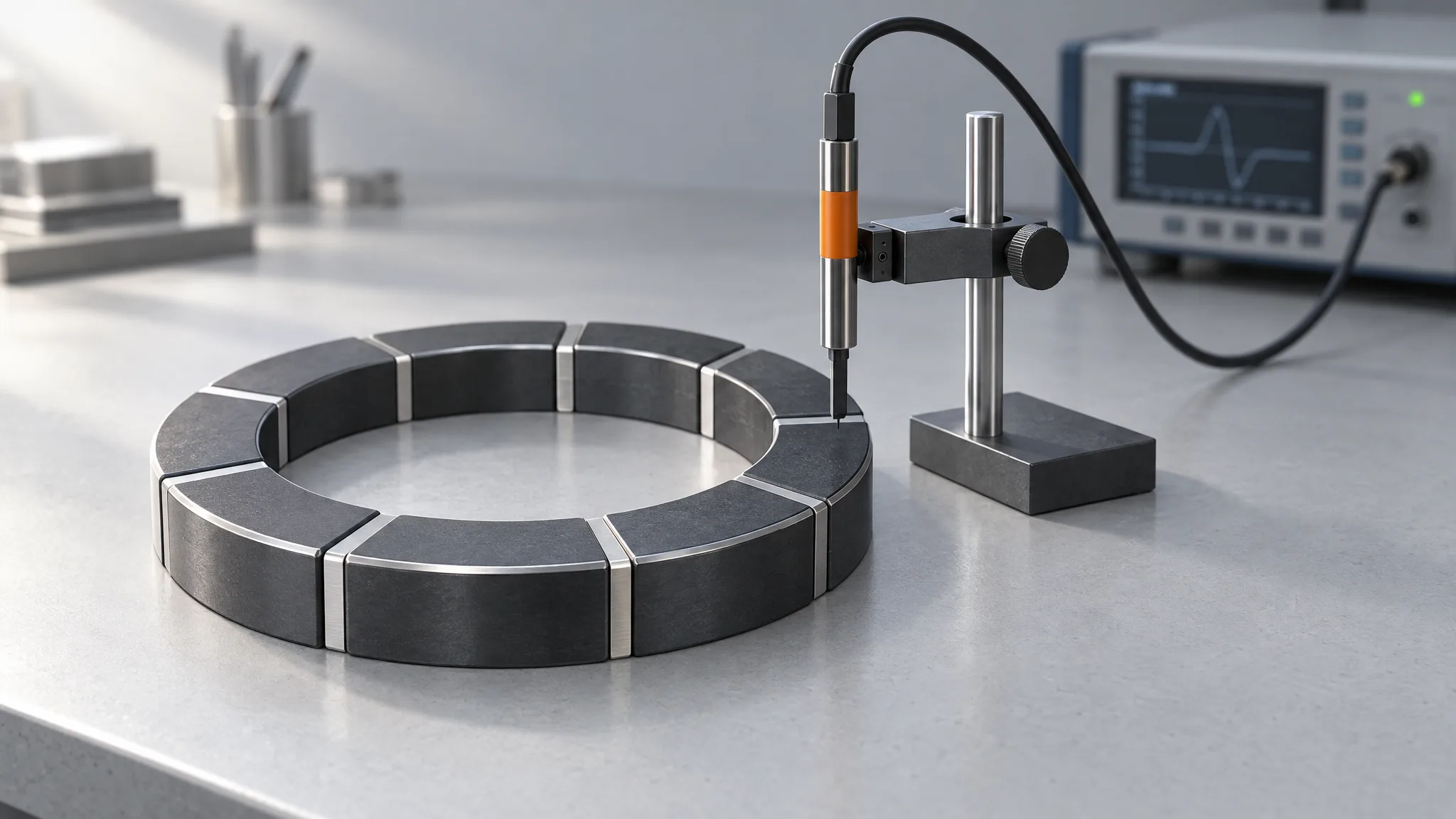
Magnet Demagnetization: Which Loads Cost Strength and Which Only Bend It
Reversible, irreversible and structural flux loss need three different answers: a working point, a drawing revision, and an order-scoped check that repeats.
Samarium cobalt vs neodymium decided at the working point, then the coating: six candidate materials, two coating routes and the hours we quote.
Articles in this topic ↓A magnet decision that looks finished on a datasheet is often only half made. Samarium cobalt vs neodymium settles the material; the coating settles what the part is worth after a year in a humid housing. Treated as one decision, both follow from the same inputs — the hot-spot temperature, the demagnetising field, the environment and the acceptance the order has to meet.
We build to drawings, so our part in the decision is narrow and concrete. You give the working point; we quote a material, a grade band and a coating against it, and the batch is checked on the items agreed for the order. What follows is the reasoning we use in that review, so that the material and the coating arrive on the drawing as one decision rather than two.
Not maximum strength. Three inputs decide it — the hot-spot temperature of the magnet itself, the demagnetising field it sits in, and the environment it is exposed to. Energy product only tells you which material needs less space to reach the field you want.
Neodymium iron boron carries the highest energy product of the rare-earth families and samarium cobalt the second, which is why the datasheet comparison looks settled before anyone mentions the application. Adams Magnetic Products makes the counter-argument in its comparison of the two materials: maximum operating temperature is not a fixed property of a grade, because it moves with the magnetic circuit. A thin section or a large air gap puts the magnet closer to the knee of its demagnetisation curve, and raising the temperature moves that knee toward the working point.
Two different losses are being discussed whenever temperature comes up, and keeping them apart is most of the decision. One is reversible: the field falls as the magnet heats and returns when it cools. The other is not — once the operating point crosses that knee, the loss stays, and re-magnetising a finished assembly in place is rarely practical, as Adams notes. A grade is chosen to keep the first loss tolerable and the second one out of reach.
The other half of the comparison is simpler. Bunting's comparison, published by Magnet Applications, puts samarium cobalt ahead once temperatures climb and notes that it resists corrosion without a special coating, while neodymium needs a coating and, at temperature, either a higher coercivity class or a heavy-rare-earth addition to keep its margin.
Where we differ is in how quickly that becomes dramatic. Samarium cobalt is the candidate when high temperature and a demanding temperature tolerance arrive together; the cost, the brittleness and the assembly stress still have to be evaluated, and it is not an unconditional guarantee against demagnetisation at temperature. Nor is neodymium the wrong answer for a hot machine: a higher coercivity class, a thicker section or a lower opposing field can keep a neodymium part inside its margin where a first glance said it could not.
Cost enters at two points, and they pull against each other. A higher coercivity class is paid for in material — SuperMagnetMan's guide gives the example of an N48H costing more than an N48, and an N48SH more again — while Bunting describes dysprosium as both rare and expensive and grain-boundary diffusion as the route that cuts how much of it a high-temperature neodymium grade needs. Samarium cobalt carries its own material cost on top. So the question is not which material is cheaper; it is which line is cheapest at the working point the drawing actually has.
Six, and only two of them are the rare earths the question usually means. A material decision that starts from a two-column table has already lost the cheaper options, so we keep the full candidate set in view and then remove from it.
| Material | Why it enters the comparison | What has to stay attached to it |
|---|---|---|
| Neodymium iron boron | The most magnetic material in the smallest envelope, for compact motor and sensor parts | Not simply "poor at heat": grade, working point, demagnetisation curve, temperature and corrosion requirement are worked out together |
| Samarium cobalt | Higher temperature and tighter temperature stability | Brittle and low in tensile strength: it chips more readily in handling and machining, so retention and bond joints are designed to keep it out of tension |
| Alnico | Temperature stability and high-temperature duty as a reason to choose it | Lower coercivity, so the magnetic circuit and any external opposing field carry most of the demagnetisation risk |
| Ferrite | Cost-sensitive motor or holding structures | The space it needs for the same field, its brittleness and its temperature conditions are all part of the sum |
| Bonded | Complex shapes and multi-pole layouts | A forming route and a composite system, not a grade with one fixed performance: powder, binder and process decide it |
| Iron-chromium-cobalt | Machinable structures and particular shapes | Heat treatment, magnetisation and circuit design each need their own review |
That table is the candidate set for a conversation, not a stock list. Availability, grade and process are confirmed project by project, and we work from drawings rather than a catalogue, so no row here is a part number to order by itself. What we hold is the build side: machining, sorting, positioning, bonding, curing and the batch checks that follow.
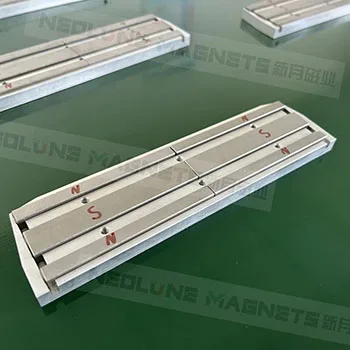
The number after N is where a grade sits on the energy-product scale; the letters SH, UH and EH mark higher coercivity classes. Neither tells you the temperature the part will take.
Those are the two labels we quote most often. Our Halbach assemblies are built with NdFeB from N35 to N54 or from the SH, UH and EH series, with samarium cobalt as the option where continuous duty at high temperature is the requirement — the specific grade following the operating point rather than the other way round. The same holds for motor magnetic components, where the structure is chosen from the motor layout first and the material second.
A class is not a thermostat. Coercivity itself falls as temperature rises, and it falls faster in neodymium than in samarium cobalt, as Adams sets out — so how much margin is left at the hot spot depends on how hard the circuit is working the magnet. Two drawings that quote the same class can therefore end up with different margins. What settles it is the hot-spot temperature rather than the ambient one, the working gap, the magnet's section in the direction of magnetisation, the opposing field from the winding, and the environment.
The environment of the part, not the environment of the machine. Humidity inside a sealed housing, a scratch from the assembly fixture and a sharp edge with thin coverage are the conditions that matter far more than the weather the equipment sits in.
Neodymium iron boron oxidises readily and needs a finish; nickel-copper-nickel is the general-purpose route and epoxy the one for humid or chemical exposure, as SuperMagnetMan sets them out. Adams points out what the finish has to endure rather than achieve: a scratch during assembly, thin coverage on a sharp edge or long exposure to humid heat can start corrosion that then runs under the plating. Samarium cobalt, by contrast, resists oxidation well enough that many industrial parts run uncoated — which also helps where a small gap needs tight dimensions and where outgassing rules out a coating in vacuum service.
The two routes we quote carry two different bands: 48 to 72 hours of salt spray for nickel-copper-nickel, and 200 hours or more for epoxy. We give them the way any coating figure should be given — beside the test conditions and the acceptance item agreed for the order, not as a general corrosion rating. An hour count with no test condition next to it is a number a buyer cannot check once the parts arrive, which is why the coating belongs in the acceptance conversation and not only in the purchase order.
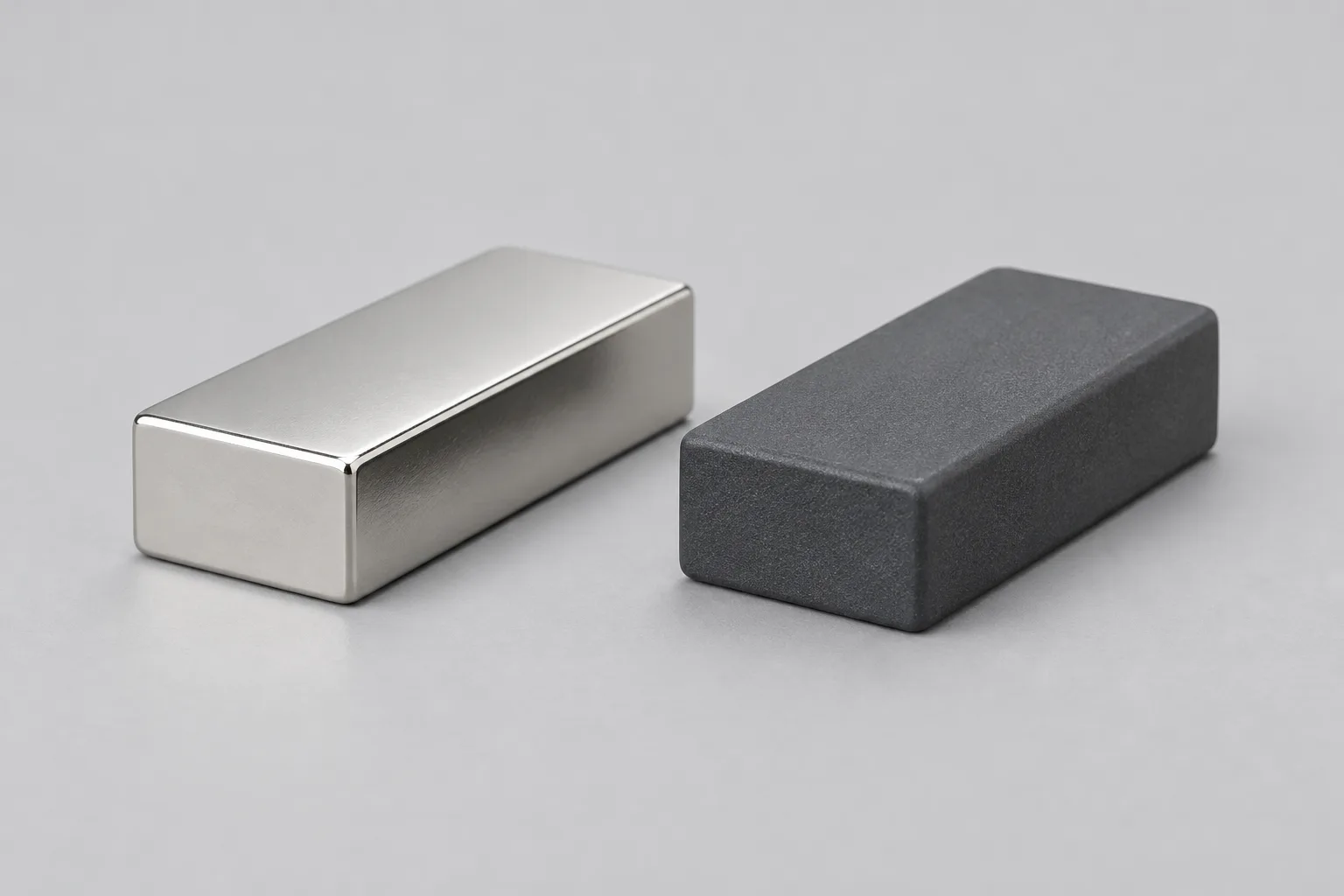
A laminated magnet makes the point sharper, because there the coating is not a separate decision at all. Segments are insulated from one another and the stack carries an overall epoxy coating, so the finish has to close the edges of a stack rather than the face of one block — which is why laminated magnets are specified with the insulation and the coating as one construction.
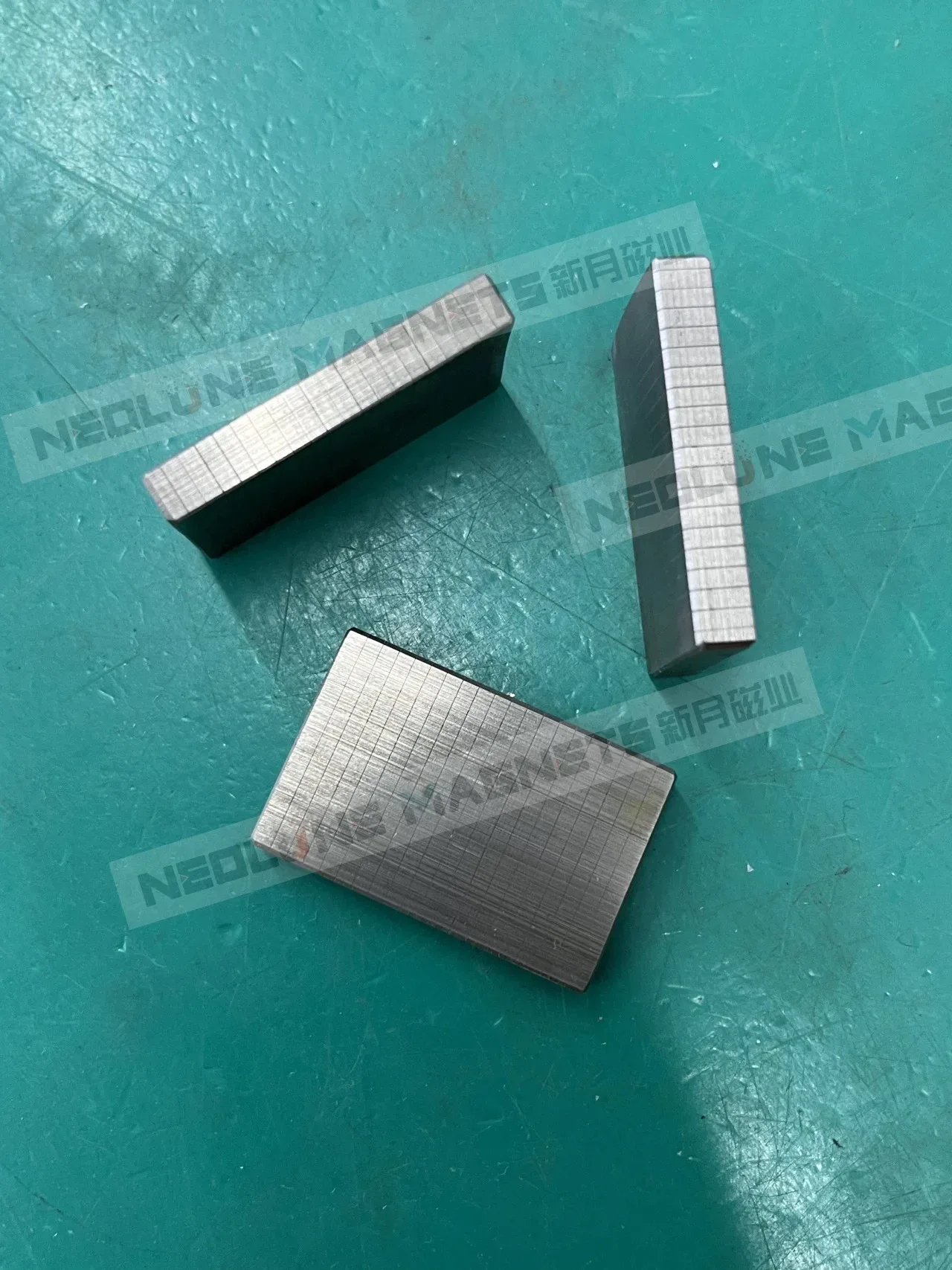
Yes, because a coating is judged on the whole life of the part, not on the box it arrives in. Handling at the bench, adhesive, curing and, in some orders, a magnetising step all happen around it after the coating is on.
We choose between bonding first and magnetising the finished part, or magnetising the segments first and bonding them under fixtures — a choice set by size and batch quantity. Each route loads the surface differently: pre-magnetised segments are handled against their own repulsion, and a chipped edge on a plated part exposes bare metal, which is exactly where corrosion begins. That is the reason a coating call belongs to the assembly route, not only to the magnet order, and why we would rather discuss it while the interface is still open than after the fixture is built.
The batch only shows what was agreed for it. The checks we discuss are dimensional, magnetic field and coating, with a temperature and demagnetisation check where the drawing calls for one; field is read in three dimensions and reported as air-gap flux density, with waveform and harmonics where they matter. Items, methods, coverage, frequency, test conditions and acceptance limits are set per order rather than promised as a fixed plan, and magnetic field, dimensional and coating reports are discussed as part of the order requirements.
Consistency across a batch is the part that resists a single number. Air-gap flux variation is controlled through the tooling and through sorting the magnets before they are placed, not by the grade label alone. Both belong in the acceptance conversation, because neither is visible in the material certificate or on the drawing's grade callout.
Five inputs, and the material and coating follow from them:
Send the drawing with those inputs and we review material, grade band and coating against them before anything is quoted. If the temperature is the variable you are least sure of, send the duty cycle as it stands; the working point is what the review needs, not a grade number chosen in advance. Send the drawing with the operating conditions and the material question becomes a calculation rather than a preference.
Reversible, irreversible and structural flux loss need three different answers: a working point, a drawing revision, and an order-scoped check that repeats.