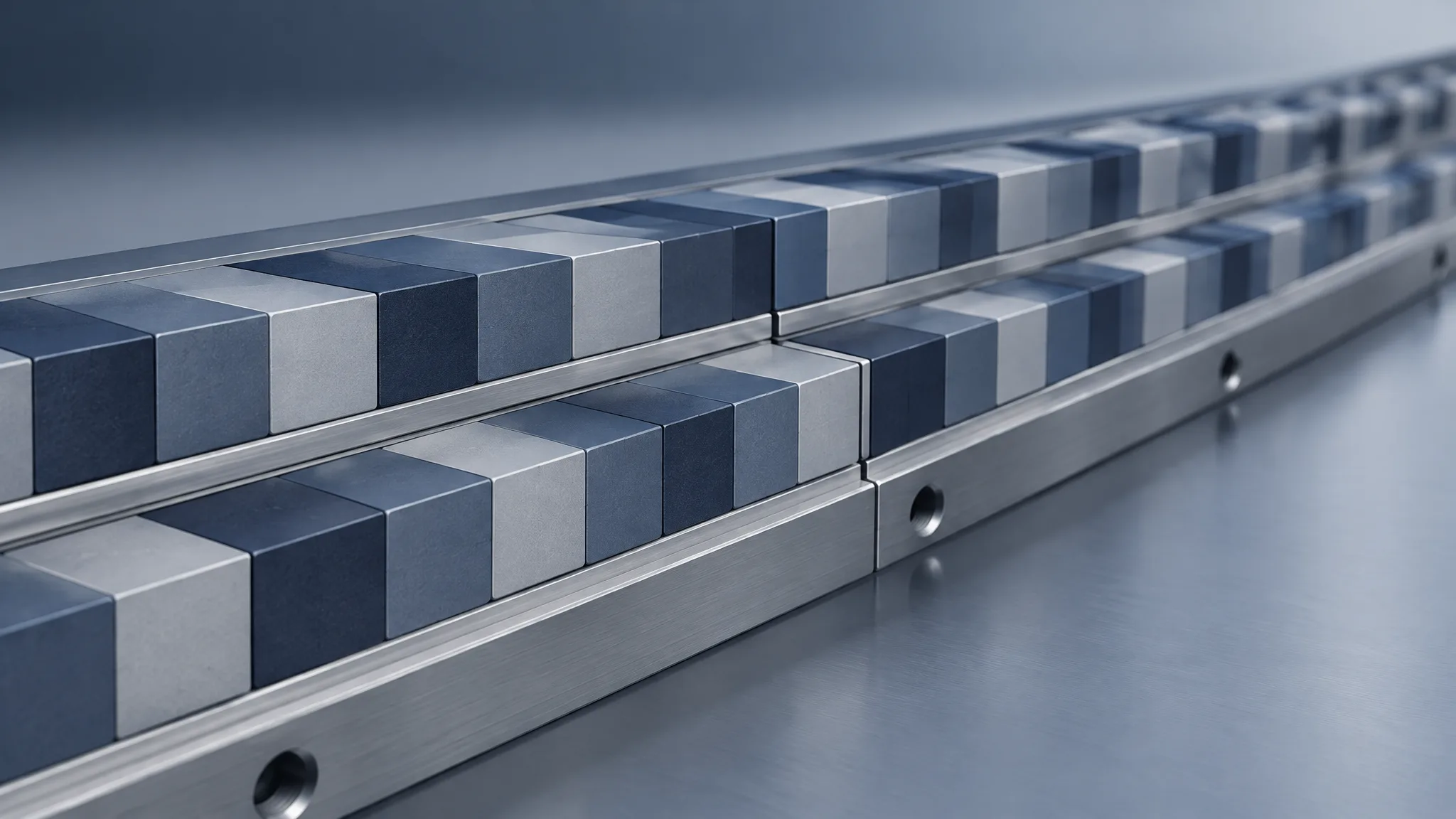
Linear Halbach Arrays: Section Lengths, Splices and Long-Travel Tracks
Where a long-travel Halbach track is cut, what the seam has to keep, who joins the sections, and which joint dimensions belong on the drawing.
Which form an axis needs, what the magnetiser envelope does to the bonding route, what the housing carries when the yoke goes, and how the field scan proves the batch.
Articles in this topic ↓A Halbach assembly is one finished part, not a box of magnets. Every segment inside it was magnetised at an angle to its neighbour, so the field adds on the face the machine works against and cancels behind it. Halbach array design is usually argued on the field side — segments per pole, angles, air-gap flux density — and that argument is necessary. It is not sufficient. Three build decisions carry as much weight, and they are settled on the drawing if they are settled at all: the envelope the magnetiser will accept, the structure that carries the array once the back iron is gone, and the route each segment takes onto the fixture.
Start from the motion, not from the magnet. A rotary axis wants a ring, or arc segments once the diameter is too large to handle as one piece. A bore that has to carry a defined field wants a cylindrical assembly built around it. A straight axis wants a linear track.
| Form | Where it fits | What fixes its geometry |
|---|---|---|
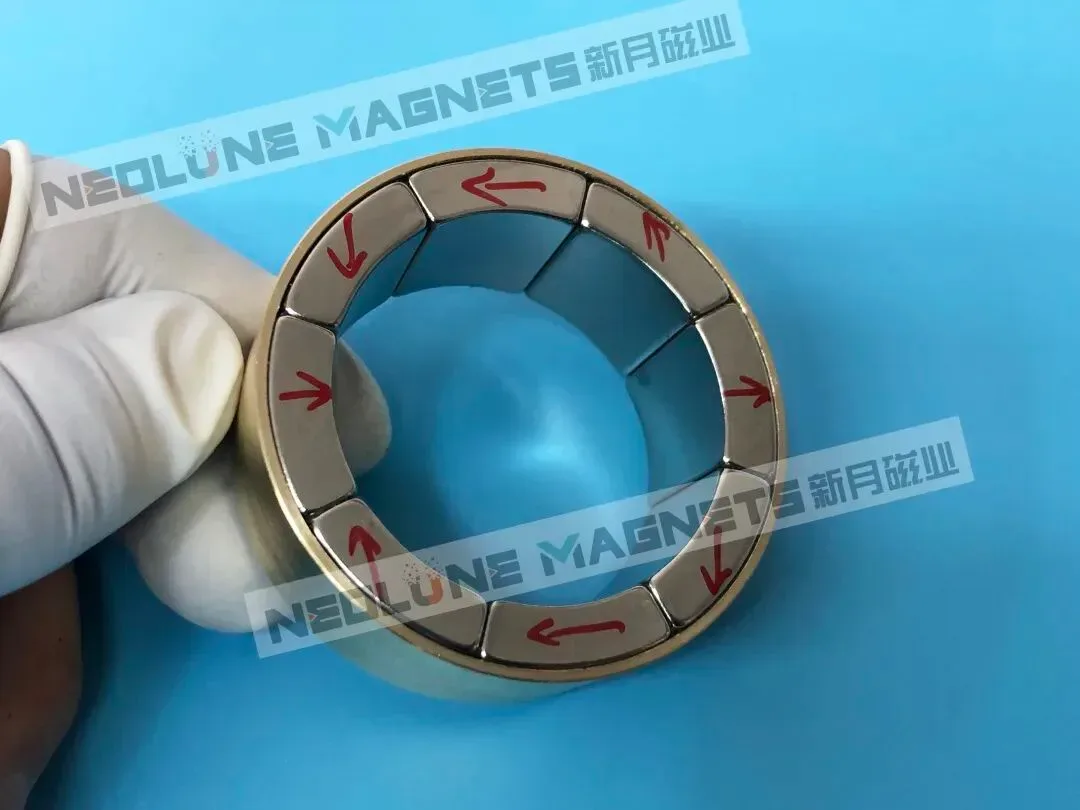
| Ring | axial-flux rotors, magnetic couplings, rotary machines | bore diameter and axial length |
| Cylindrical | equipment built around a bore | bore, outer diameter, mounting face |
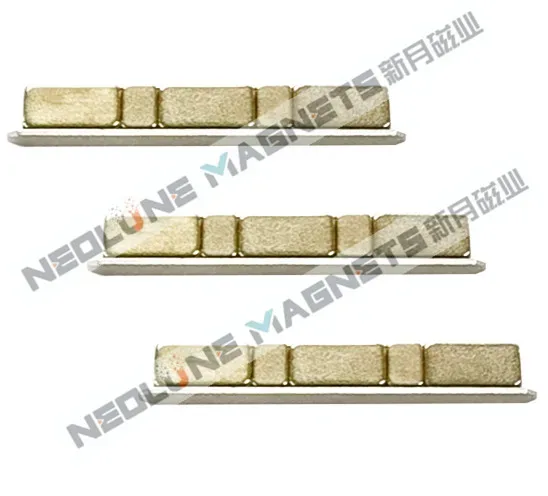
| Linear track | linear motors, positioning stages, long travel | section length, splice points, support strip |
| Arc segment | rotors and stators too large for one ring | arc angle, fastener positions |
Rings, cylinders, linear tracks and arcs are the four forms in our Halbach assembly range, and the ranges are the ones we build to: ring bores from φ10 to 400 mm, linear sections of 10 to 600 mm that can be joined into longer travel, and magnets no thinner than 2 mm. Those ranges describe work we already run, so treat them as the starting envelope for a conversation; the specification of any one part still comes from its drawing and from the acceptance conditions agreed for the order.
Five inputs. The target air-gap flux density, the working air gap, the envelope and installation limits, the operating temperature, and the application with its speed and quantity. Published guidance works from a similar list of design variables — the working gap, the environment, external demagnetising fields, service life, cost and the volume available — and Adams Magnetic Products adds field uniformity, the strong side against the quiet side, and tolerance sensitivity in its list of modelling inputs.
From those inputs three things come back: how many segments the array needs, at which angles, and which grade suits the temperature and the duty. That is what drawing review and magnetic simulation is for in our process — the drawing sets the geometry, the field target sets the pattern, and the simulation tests one against the other before any magnet is machined.
The step between segments deserves most of that attention, because it is what separates a Halbach pattern from an ordinary alternating array. A 90° step is the common, coarse version; 45° steps sit closer to a continuous rotation of the direction. Past a certain resolution the manufacturing difficulty outweighs the field it buys, as Dura Magnetics' design-variable guide puts it. Where that point falls is not a rule of thumb: it moves with the air gap, the number of poles and how much assembly the part can take.
The step is also where the field side meets the build side. Every further subdivision adds a part, an angle to magnetise and a joint the fixture has to hold, which is why we do not fix the segment count in one meeting and the grade in the next. Simulation trades the two against each other, so that the working field is met while the magnet mass stays down — and the answer arrives as one proposal, not as three separate numbers to reconcile.
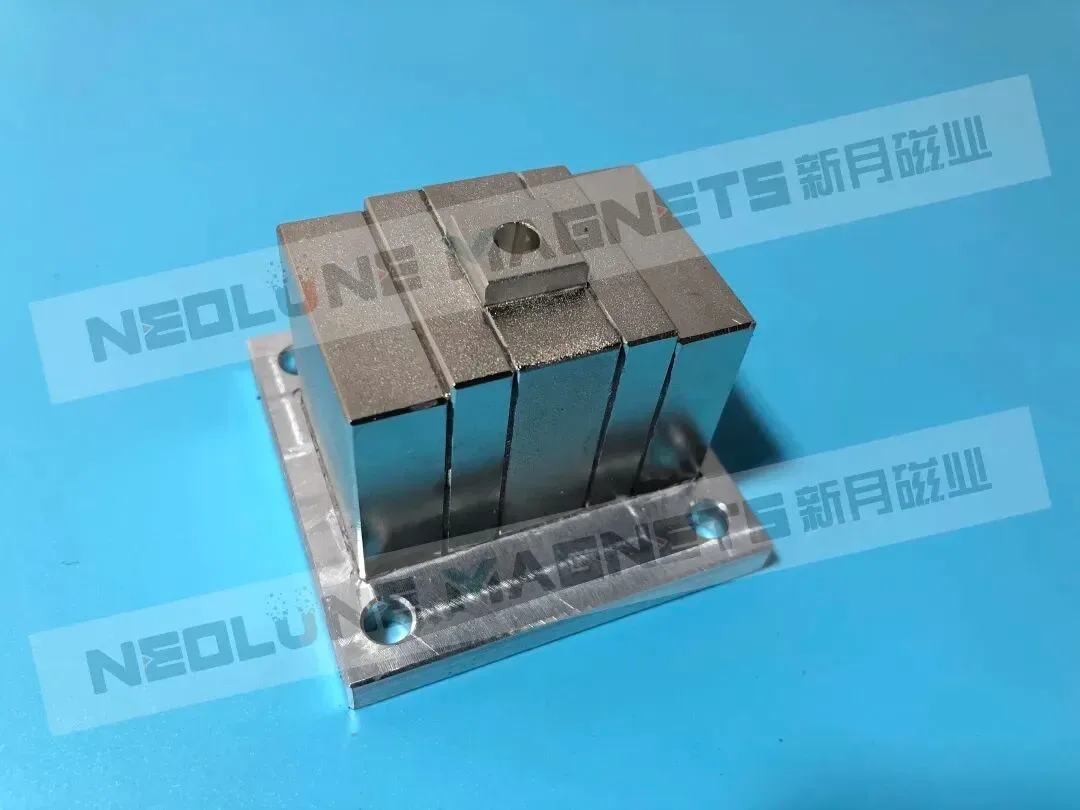
Ask what the back of the array is doing. In a Halbach pattern it is doing very little: the field there cancels, which is why the heavy steel backing plate of a conventional array can be dropped. What cannot be dropped is the load. A back-iron-free assembly is held by the customer's own structure — a housing, a clamp, a sleeve — so that structure has to locate the segment stack and carry the forces, and the interface has to be settled on the drawing rather than at assembly. The housing then does the locating, so its material and the clearance to the magnets are agreed with us before the drawing is released, not discovered on the bench.
A based assembly moves that problem to us. The segments are bonded to a carrier with its own mounting face and fastening holes, and the interface the machine sees is defined before the first magnet is placed.
Sometimes, and the answer is arithmetic rather than preference. Two routes exist. Magnetise each segment first, then bond it into the array under fixtures that hold it against the repulsion of its neighbours; that is how large rings and long tracks are built. Or bond the complete ring first and magnetise it afterwards, which takes the repulsion off the assembly bench entirely but works only while the ring fits inside the magnetiser.
This is where our route can differ from the usual published advice: Radialmagnet describes pre-magnetised assembly as the norm, on the grounds that a finished Halbach array generally cannot be pulse-magnetised as a unit. Where the ring fits the magnetiser cavity, we bond first and magnetise the finished part, which keeps the repulsion out of the assembly step; where it does not, the segments are charged first and the fixture does the holding. Which route a part gets is decided by its size and its batch quantity, not by habit.
Magnet material is one line of the price. The others are multi-angle magnetisation, the tooling that resists the repulsion while the adhesive cures, and the three-dimensional field scan — and then the scrap risk of an array that only proves itself after the segments are bonded. The process threshold is in the quotation whether or not it is written down.
Two levers move it without touching the field target. Simulation can optimise segment count and grade selection together, using less magnet material for the same working field where the waveform allows it. And a back-iron-free delivery can lower the cost of the whole machine even though the assembly itself costs more than a conventional one, because the yoke is no longer machined and carried. Neither lever replaces the other, and both are settled before tooling starts.
A finished assembly, packed for transport, and the evidence that it is the one you ordered. We scan the field in three dimensions and read back the air-gap flux density, how close the waveform is to a sine and its harmonic content. Field, dimensional and coating reports can be supplied, with the check items, the coverage and the report content agreed per project rather than assumed.
Timing follows agreed conditions in the same way. A mature drawing typically samples in 5–8 working days, a new design with tooling in 7–15, and production typically runs 15–30, with the clock starting after the drawing is confirmed and the sample payment is received. A prototype can start from one set.
Send the drawing with the target field, the working gap, the envelope, the operating temperature, the speed and the quantity, and we will review the array against them before anything is quoted — send it with the drawing and the review starts from the design rather than from a catalogue number. A drawing sent early is cheaper than a fixture built twice.
Where a long-travel Halbach track is cut, what the seam has to keep, who joins the sections, and which joint dimensions belong on the drawing.